
Beyond Training and HBM: Why Cerebras Is A Great Revolution Investment
One of the most important tenets of Revolution Investing is that the most energy and economic efficient solutions always win out over time. Right now, the entire tech industry is locked in a consensus trade: AI Datacenter Bottlenecks…


One of the most important tenets of Revolution Investing is that the most energy and economic efficient solutions always win out over time. Right now, the entire tech industry is locked in a consensus trade: AI Datacenter Bottlenecks… especially High-Bandwidth Memory (HBM) along with fiber optics and energy hardware. But if you’ve been following my work, you know that the biggest multi-bagger alpha rarely comes from following the crowd into a supply-constrained bottleneck. Instead, the real money is made when you identify a structural market wall that everyone else is ignoring and back the company that is actually tearing it down.
That’s exactly why we’ve started to build a new position in Cerebras. While the market obsesses over the episodic, capital-intensive spikes of training AI models and cloud datacenter hardware constraints, they are missing the real structural shift: the 24/7/365 operational grind of inference. With 70% to 90% of AI processing power now dedicated to running models in production—not building them—the industry is hitting a major wall. The traditional, HBM-laden GPU cluster has become a margin-crushing tax on every AI token generated, and it’s finally becoming cost-prohibitive.
Meanwhile, Cerebras isn't just another chip company; they’ve engineered an "anti-HBM" system that bypasses the supply constraints and energy inefficiencies that are currently choking the incumbents. It’s a classic Revolution Investing setup: a disruptive technology that solves the economic bottleneck of the next decade of AI compute.
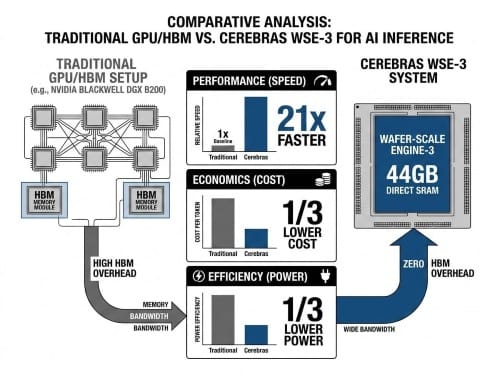
Cerebras builds technology for AI datacenters that enable inference to be done in a completely new way that’s more energy efficient, faster and overall a more economic solution than even Nvidia’s latest and greatest chipsets for the datacenter. The Cerebras CS-3 system is 21x faster, 1/3 lower cost, and 1/3 lower power than Nvidia’s flagship DGX B200 Blackwell GPU. Cerebras systems are not designed for training AI and LLMs which Nvidia’s platform still dominates today and will continue to dominate for many years to come.
And that’s fine. Because while training AI is important, it’s not where most of the AI processing happens on a daily basis. On a daily basis, the distribution of AI processing power and compute spend has decisively shifted since the early days of ChatGPT and The AI Revolution, with inference (running models in production) consuming roughly 70% to 90% of daily resources, while training (building or fine-tuning models) takes up the remaining 10% to 30%. While training commands massive, highly publicized multi-million-dollar compute spikes over the course of weeks or months, its operational profile is episodic. Inference, conversely, is an unbounded operational expense running 24/7/365 to serve millions of user requests, tokens, and agentic workflows simultaneously. And that share of compute being used for inference vs training is still growing.
Said another way, more than 90% of all the compute power that the trillions of dollars that datacenter builders will spend on building their AI platforms and AI cloud businesses will be utilized for day-to-day inference -- think of AI-generated videos, pictures, code and even just the random hourly conversations and queries that people use AI for. The need for inference is what the vast majority of AI datacenter compute will meet and it’s why the datacenter companies are spending those trillions of dollars on datacenter capex.
So you can imagine the intense focus on trying to make sure all the margins on all that inference compute is going to as maximized as possible. And that means two primary things: Faster processing and more energy efficiency. That’s what Cerebras is built to deliver.
And, again, there’s one other very important factor that went into our bullishness on this new position. That is to say that Cerebras is the anti-HBM solution. If you've been watching the hyper-scale AI boom over the last couple of years, you know that for the last year the absolute consensus analysis has been that high-bandwidth memory is no longer cyclical or competitive.
But if you want to find the real multi-bagger alpha in this tech revolution, you have to look for the anti-consensus play. You have to look at the anti-HBM technology because before the last year or so when HBM prices went absolutely vertical, the massive tech conglomerates running these AI data centers looked at HBM as a de minimis input cost—a tiny, rounding-error line item on a motherboard dominated by the cost of the main processor logic. You bought your massive GPU cluster, you slapped some memory next to it, and you didn't think twice about the bill.
Not anymore.
Today, every single AI data center company on the planet is hitting a structural wall. As LLM models have exploded into hundreds of billions of parameters, the sheer volume of data that needs to be sucked out of memory and jammed into the processing cores has skyrocketed. The industry's solution? String together tens of thousands of individual chips, packing each one to the gills with expensive, supply-constrained HBM layers.
Suddenly, HBM has gone from a de minimis input cost to something that is flat-out cost-prohibitive. It's choking data center budgets, it's heavily supply-constrained at the foundry level, and it’s acting as a massive tax on every single token an AI model generates.
This is exactly where the genius of Cerebras CEO, Andrew Feldman, and his long-time team comes into play. Instead of trying to build a faster, more expensive straw to suck data out of a distant HBM bucket, Cerebras decided to just build a bigger mouth.
They built the Wafer-Scale Engine (WSE-3)—a single, continuous piece of silicon the size of a dinner plate. And here is the ultimate anti-HBM kicker: they don't use HBM.

Instead of chasing external memory arrays, Cerebras stamps 44 gigabytes of lightning-fast SRAM directly onto the silicon die itself.
- Zero HBM Overhead: Because the memory sits directly on the silicon logic cores, the data doesn't have to travel across a slow, hot, expensive external wire.
- 15x the Speed: This structural design gives them pure, unadulterated internal memory bandwidth, letting them stream out sequential AI text tokens up to 15 times faster than traditional GPU setups.
- Pure Cost Deflation: By completely bypassing the industry-wide HBM supply bottlenecks (and ignoring packaging constraints like CoWoS), Cerebras escapes the margin-crushing cost trap that every other infrastructure company is complaining about.
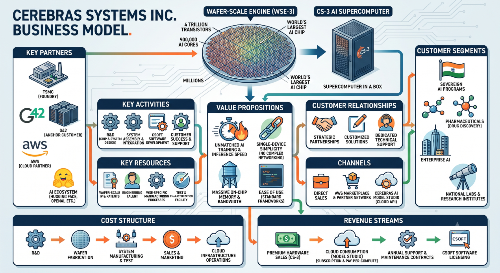
When you look at their financial trajectory, you can see why the Street will soon be scrambling to re-rate this thing. We’re modeling our numbers quite conservatively for this company over the next five years as their disaggregated inference partnerships roll out and we still see revenues going from less than a billion this year to more than $3 billion next year and over $20 billion five years from now, in the year 2030.
The bears will tell you that fitting an entire state-of-the-art model onto 44GB of SRAM is impossible. But they're missing the forest for the trees. By using their custom "Weight Streaming" pipeline and pairing up with hyper-scalers to handle the heavy front-end prompt processing, Cerebras is proving you don't need to hoard billions of dollars of cost-prohibitive HBM to win the fast-inference race.
In a gold rush where the price of traditional shovels is becoming too expensive to justify the mining, Cerebras has invented a completely different way to dig. It’s exactly the kind of solution that I’ve been talking about when I explain to people that every HBM customer on the planet is trying to figure out any alternative solution now that HBM is a cost-prohibitive constraint on their growth.
Keep your eyes on this structural shift—it's exactly where the real market-moving disruptions happen.
In the last few months, we’ve aggressively built up two of our new positions because the stock price for each had come down to a level where we saw great value with lots of potential upside. Last time it was Arm Holdings, which we aggressively built into a 5% position in the funds when we first started buying it back in January when the stock was around $100 a share. This time, it’s Cerebras, which we just started buying around $185 a share. Each company provides the most energy/economically efficient solutions in their respective markets inside of what will be one of the largest and economically- and societally-important Technological Revolutions in all of history builds over the next five to ten years.
And it’s the potential and returns on companies like these that are exactly why we’re Revolution Investors.
We'll do the Live Q&A Chat this Wednesday (July 15) at 12:00pm ET in the Discord channel, or you can email your questions to support@tradingwithcody.com.