
MUST READ: Humanity’s Next 25 Years Will Dwarf All History




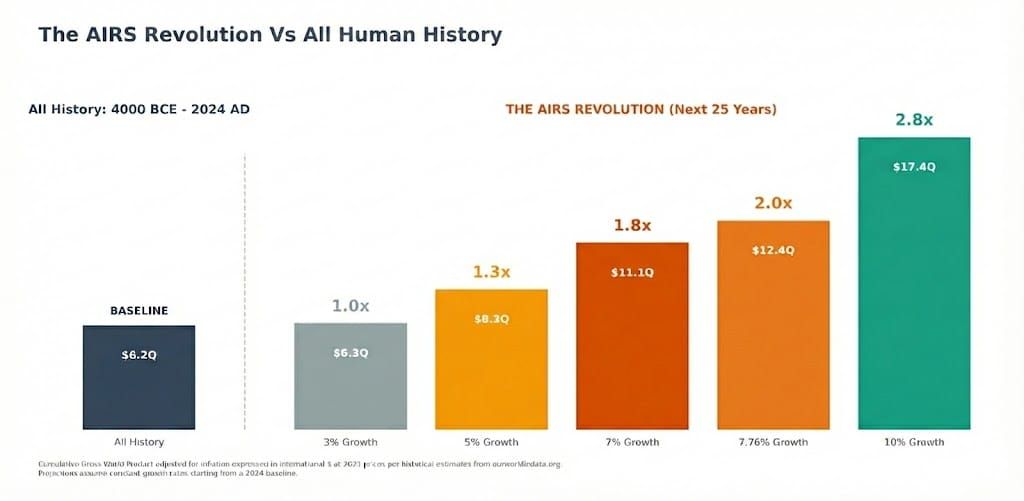
Cody’s Editor Note: While I was traveling in London a couple weeks ago, I had this epiphany about just how much value creation has been done in the last 25 years and just how much we should probably expect to see over the next 25 years …and I haven’t been able to stop thinking about it since. What you’re about to read will blow your mind. Frankly, it’s probably the most succinct, accurate and important analysis that I’ve ever produced and it’s relevant for any and all investors out there because it underscores how Tech Revolutions are what drive most of the prosperity, wealth and gains in the economy and markets over time. This topic is so important and so far-reaching and so core to the investing approach I have taken in my career that we’re going to continue to explore and explain this analysis for the next few months in a series of articles that we will also eventually turn into our next – and most important ever! – book (we’ll be folding the long-planned, but still unfinished AI Revolution book into this one). All right, folks, buckle up and hold onto your socks. Let’s blow some minds.
I want you to do some deep thinking. Let’s think of every fortune in the last 6,000 years (since the beginning of human civilization), including The House of Orleans, Mansa Musa, John D. Rockefeller, Cornelius Vanderbilt, Jeff Bezos and Elon Musk. Think of all the miraculous achievements that humankind built in that amount of time, from the Roman aqueducts to the entire electrical grid, the Internet, every software program, every video game, every professional sport league, all modern industry, smartphones, satellites… every economic transaction, every purchase, every building, every highway, etc etc etc. Think of the cumulative effort of the roughly 117 billion people that have lived on this Earth.
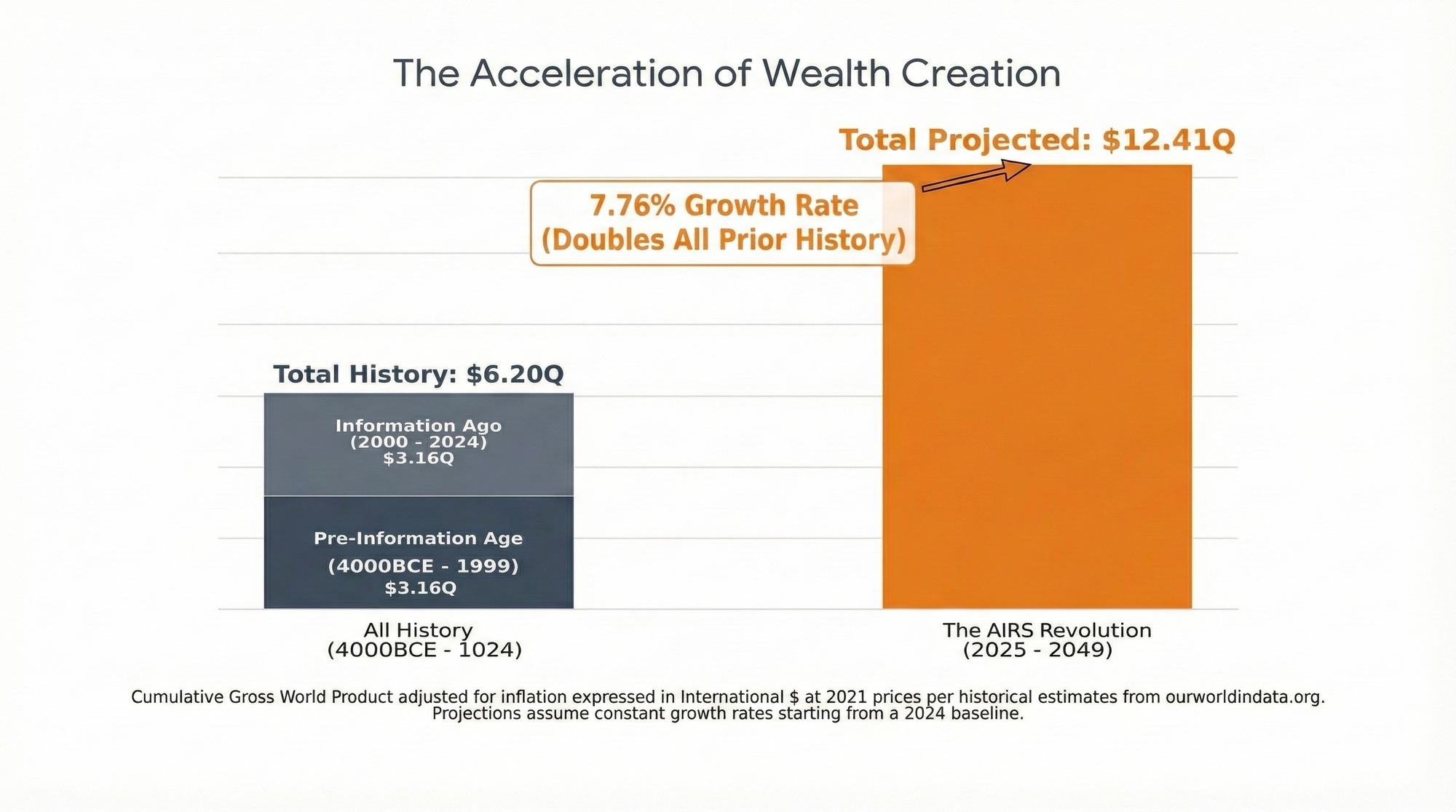
Now realize that half of all that wealth, prosperity, value, services, applications, buildings and products were built over just the last 25 years, during the “Information Age.” You read that right. More importantly, over the next 25 years, we will produce more than 2x all of the wealth, prosperity, value, services, applications, buildings and other products produced during the last 25 years.
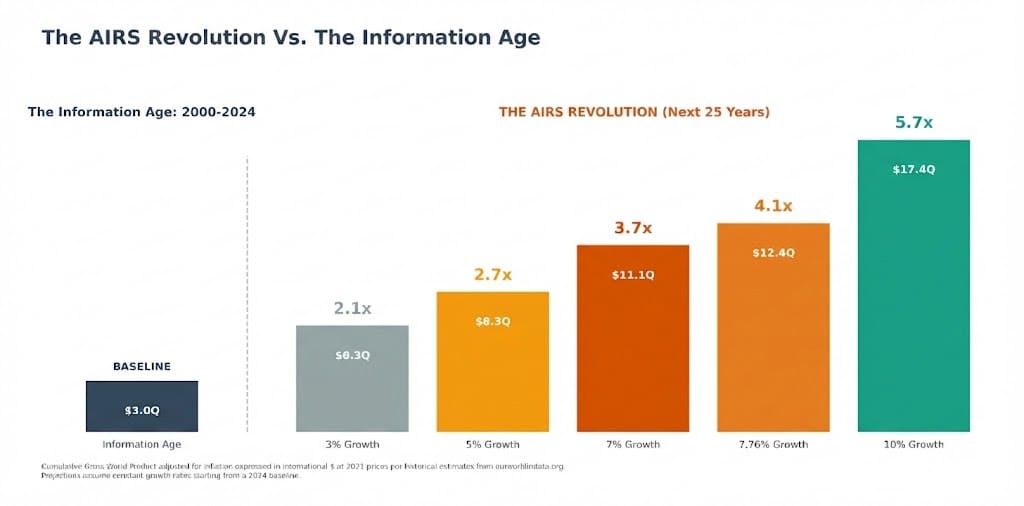
And even MORE importantly, at just 3% annualized growth, the economy will produce about the same amount of wealth in the next 25 years as it did in all of human history combined!
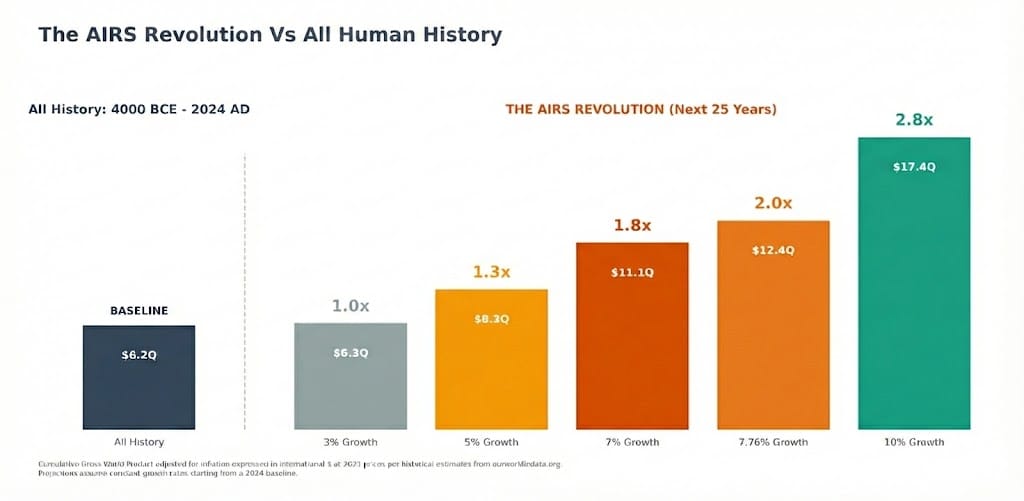
Moreover, there’s a better than 0% chance (and probably better than 50% chance) that we double or triple the entire sum of historical gross world product (GWP) in the next 25 years. At a 7.76% real growth rate, we would produce 2x the amount of wealth in the next 25 years compared to the last 6025 years combined.
This is possible because:
- The AI Revolution is about to revolutionize all white collar jobs and make supply chains, customer resource management and other facets of business incredibly more efficient, which will enable all white collar workers to be 2-10 times more productive, and
- The Robotics Revolution is about to revolutionize all blue collar and all health care and other physical jobs, making them incredibly more efficient and 2-10 times more productive, and
- The Space Revolution is about to take our earthly GWP to a galactic GWP over the next 25 years.
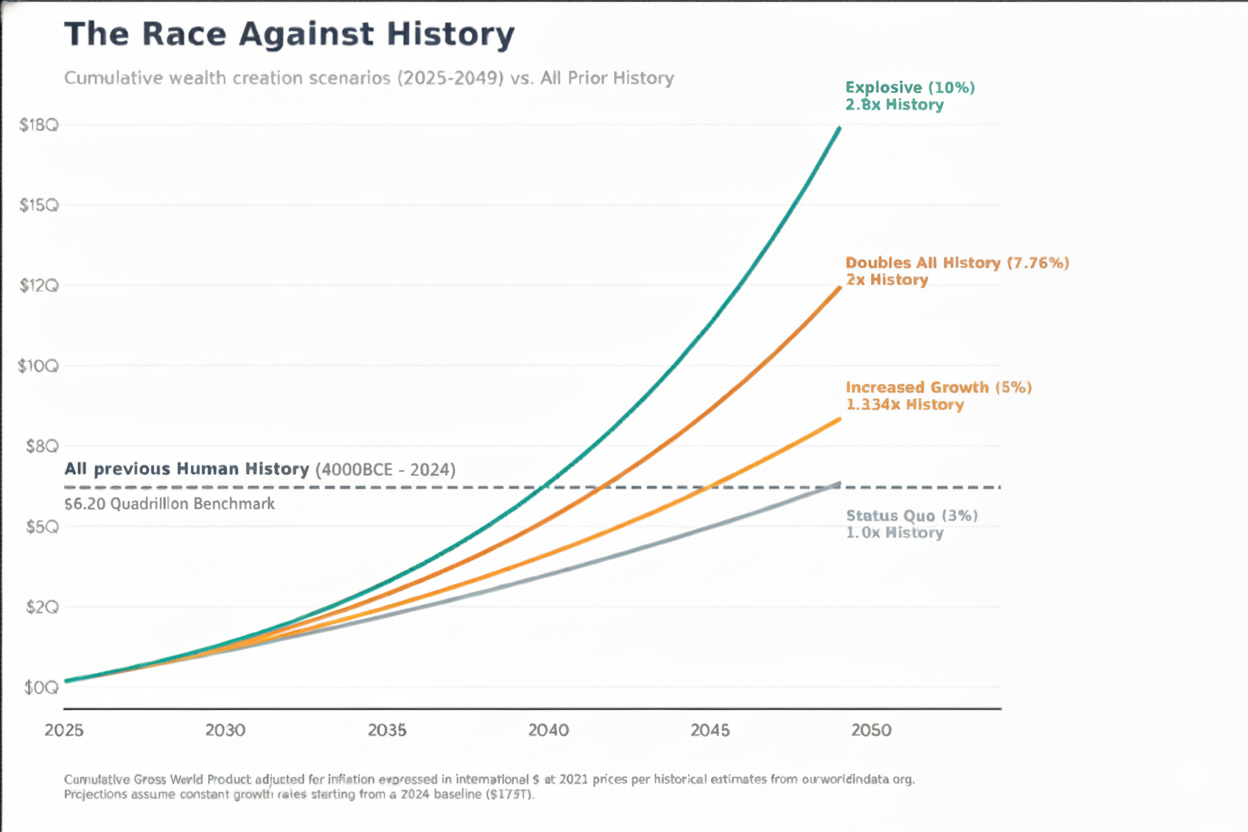
Craig made an interactive AI app using the model shown above which you can play with at RevolutionInvesting.AI.
Furthermore, earnings/profits/operating margins were stagnant for most of the 1700s to the 1900s, but with the advent of computers, internet, mobile devices, apps, software, etc, earnings/profits/operating margins secularly expanded dramatically over the last 25 years. AI and Robotics will obviously help that trend of expanding earnings/profits and margins over the next 25 years too (perhaps even at an accelerating pace).
The amazing growth, higher margins, and wealth creation we witnessed over the last quarter century obviously showed up in the stock market.
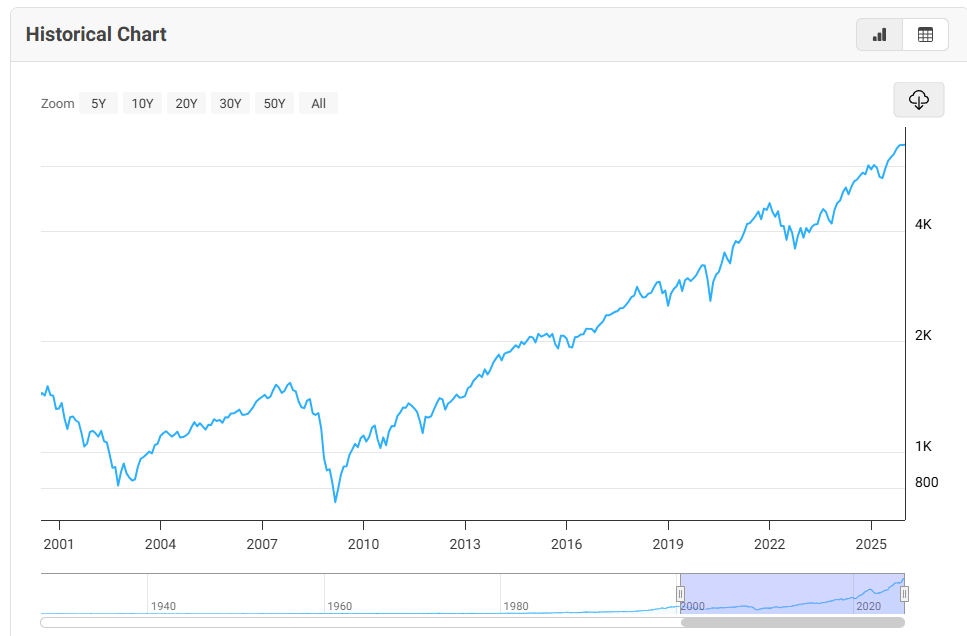
You might think that these kind of returns were unique to the last 25 years, but just consider what the charts looked like coming into the millennium:
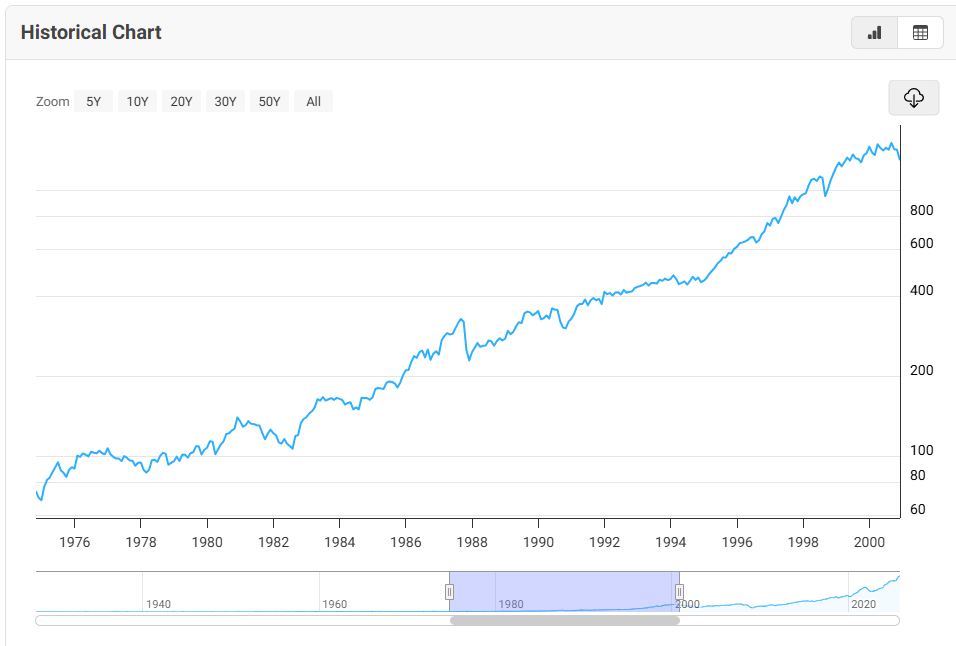
Pretty much the same "up and to the right" dynamic. So even if you bought in the highs of the 2000 bubble, you still saw fantastic returns over the next quarter century because of the amazing wealth creation (the economic doubling of the prior 2000 years) we saw in the 25 tech-empowered years that followed. And what about the 25 years before that (1950-1975)?
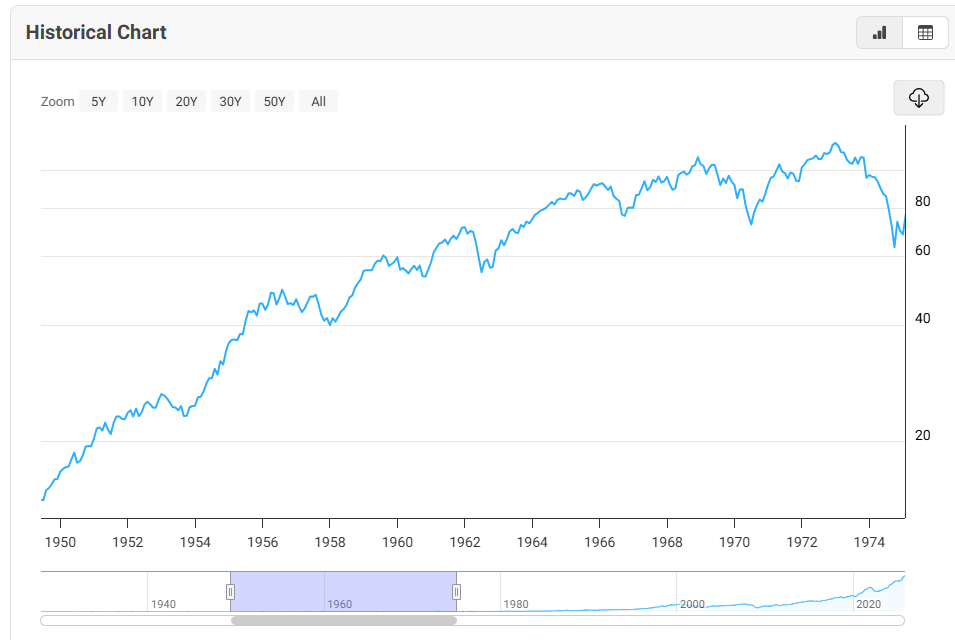
Remarkably, pretty much up and to the right. Obviously, there are hiccups and downright crashes along the way (as there will continue to be), but we can see that in almost any 25-year period of the markets within the last 75 years – since tech (chips, computers, internet, smartphones, etc.) – really took off, buying even at the short/medium-term tops still yielded fantastic results over a 25-year investment period.
And to be clear, tech was the primary wealth creator of the last 50 years, and it notably accelerated in the last 25 years (The Information Age). In the years before 2000, a good chunk of the growth in GWP was driven by population growth. From 1975 to 2000, the population grew from ~4 billion to 6.2 billion, a 1.77% CAGR. However, in the most recent quarter century, population growth slowed to 1.12% per year. Meanwhile, the rate of real GWP growth expanded to 3.35% from 2.9% annually.
Despite the fears of most economists, the GWP growth rate is most likely going to continue to accelerate as tech Revolutions drive even more productivity gains. With The AI, Robotics, and Space Revolutions coming down the pike, human productivity is about to explode, leading to even higher wealth creation per capita compared to the prior quarter century, which was in and of itself greater than the 6000 years that preceded it.
However, the wealth created over the last 25 years was not evenly distributed. While just betting on the markets themselves was great, picking the winners of the tech Revolutions yielded truly fantastic results. The tech companies which drove the radical improvement in human productivity obviously captured most of the value, and that’s reflected in their outperformance of the market over the last 25 years. If we look back, the median compounded annual growth rate (CAGR) of the largest 8 tech companies was about 25% per year (25 years, 25% per year? Seems sort of mystical). That dramatically outperformed the S&P 500, which only returned about 7% per year.
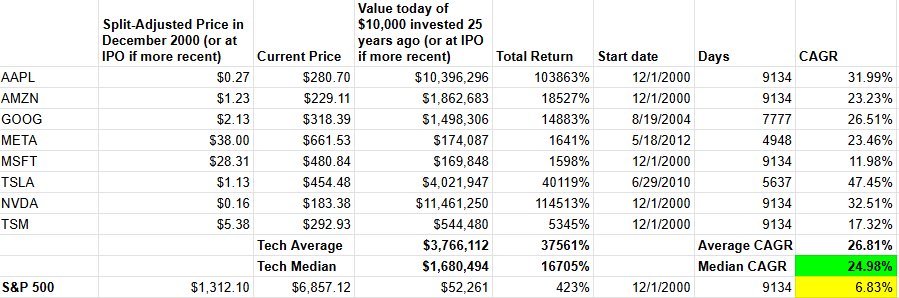
Isn’t it wild that we’ve famously owned seven of these eight companies (no MSFT) for years/decades? And while 25% per year may not sound absolutely crazy, a $10,000 investment in just one of these companies yielded a median ending value of $1.7 million, compared to an ending value of just $52,261 if you invested in the S&P 500.
Other sectors that are not tech-based will also do very well over the next 25 years as these Tech Revolutions drive the economy and markets higher. But the vast majority of the hundreds of trillions of dollars of new wealth created over the next 25 years will be done by Revolutionary Tech companies, just as it was over the last 25 years and even over the last few hundred years.
Now let’s hit on inflation, as that is always a big concern for economists and is supposedly "bad" for tech. The economic returns we’re discussing over the next quarter century are real returns, i.e. the real increase in wealth and purchasing power (our 3% model is only slightly higher than the consensus 2% growth estimate). But interestingly enough, as long as inflation/deflation stays within reasonable bounds (say within -2% to +4%), the net effect of inflation is actually positive for stock ownership. While inflation erodes purchasing power, it generally correlates with increased nominal financial asset prices over the long term. A distinction must be drawn between "real-world inflation" (the rising cost of goods like eggs) and "financial asset inflation" (the rising value of stocks). Over a multi-decade horizon, equities tend to act as a hedge against currency devaluation because financial assets are distinct from fiat currency; as the supply of dollars expands, the nominal value of finite assets—such as company equity—rises relative to that currency. Consequently, a moderate level of inflation can boost stock returns on paper, even if it does not reflect an increase in real economic output or prosperity.
Moreover, as the population has grown exponentially wealthier over the last 50 years, and especially the last 25 years, we allocate a much higher percentage of our income to asset ownership, rather than spending. Especially post COVID, we have observed a phenomenon where liquidity flows disproportionately into financial assets rather than consumer goods. This is accelerated by the structural shift in how society allocates capital, with a growing percentage of income being funneled into markets and assets rather than consumption (the "financialization" or "RobinHoodization" of the economy). The huge rise in stock ownership by individuals, the explosion of crypto/sports betting/prediction markets, are all the result of relatively wealthier people allocating a relatively higher percentage of their income to asset ownership. That results in stock prices generally trending upward with inflation (unfortunately it also invites a lot of grifting, fraud, and mindless speculation). Of course, if inflation blows way past the long-term norms (like when it shot to 9% post COVID), that shocks the whole system and can be bad for asset prices in the short term (i.e. 2022). But outside of that, mild inflation actually isn’t too big of a problem for people investing in tech Revolutions, like us.
All of this doesn’t mean we won’t have market downturns, crashes, bubbles and economic cycles over the next 25 years. After all, we did have three serious economic recessions and three market crashes over the last 25 years even as we doubled all the prior economic activity of history. But over the last 25 years, as long as the investor was able to survive those market crashes, you made a ton of money in the long term. And over the next 25 years, if we’re right that the global economy can grow by at least 3% (or much more than that) and if margins stay here or (much more likely, actually expand) we will, by definition, see the stock markets go up by tens of trillions or even hundreds of trillions of dollars.
We have to remember that technological innovation (and Revolution) happens at an ever accelerating pace, as I’ve explained many times over the years. There will be as many or more medical breakthroughs, architectural achievements, communications applications, software step changes, etc over the next 25 years as there were in all of history too.
Therefore, the two most important Revolution Investor takeaways are as follows.
- Invest in Revolutionary Technology. I mean, most of those many trillions of dollars of market cap that will be created over the next 25 years will, of course, be created by technology companies, specifically those companies driving The AI, Robotics and Space Revolutions. We only have to find a few of those 25%+ CAGR compounders to achieve fantastic results.
- Focus on shorting individual names, not indices or ETFs because they have survivor bias over time as they replace losers with winners. There will still be thousands, literally thousands of stocks that will go to zero over the next 25 years, just like there were over the last 25 years and like there always are over the decades.
In conclusion, there’s literally never been a better time to be a Revolution Investor than right here, right now as there’s never been another time in history where tens or hundreds of trillions of dollars of revenue, earnings, profits – and most importantly – market cap are about to be created in the span of less than 10,000 days.
Said another way – it will take less than 10,000 days to create as much GWP, earnings and market capitalization value as was created over the last 2,190,000 days.